Part Two: Overfed and Undernourished
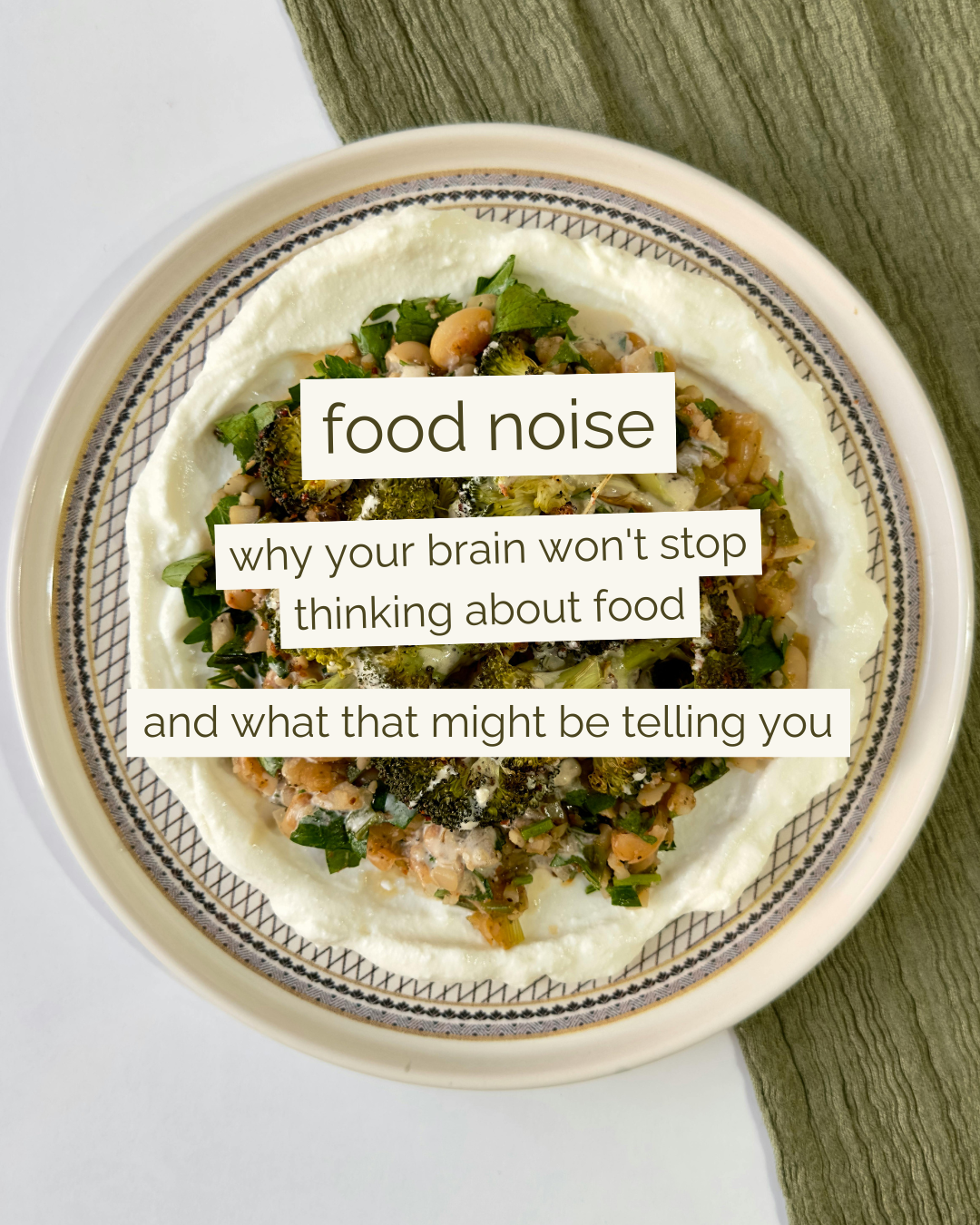
Food noise. If you haven't heard the term yet, you will.
It's the constant mental hum around food. The thinking, planning, craving, negotiating. The way food occupies your headspace even when you're not hungry, not eating, and genuinely trying to think about something else entirely.
It has become one of the most talked-about topics in wellness right now, largely because GLP-1 medications like Ozempic and Wegovy have shown that when you chemically quiet the hunger signal, the noise often goes quiet too. And for many women, that quiet feels like relief they didn't know was possible.
But here is what I want you to consider.
Silence is not the same as nourishment.
Food noise is not a character flaw or a lack of willpower. It is a complex biological and psychological experience, driven by your hormones, your brain chemistry, your history with food, and the world you live in. Understanding what's driving it changes everything about how you respond to it.
What's Actually Driving the Noise
Your hormones are talking, loudly
Your body runs a sophisticated hunger-satiety loop. Ghrelin signals hunger. GLP-1 and leptin signal fullness. When these hormones are in balance, food occupies a reasonable amount of mental space — you get hungry, you eat, you move on.
But when the body senses scarcity, through restrictive dieting, skipping meals, or chronic under-eating, ghrelin spikes and satiety hormones drop. Your brain interprets this as a survival emergency and responds accordingly. The noise gets louder. The preoccupation with food intensifies. This is not weakness. This is biology doing exactly what it was designed to do.
The reward pathway
Ultra-processed foods, engineered to hit the precise combination of sugar, fat, and salt that lights up your brain's reward centers, create a dopamine-driven loop of wanting. Not just while you're eating. Long after. The craving isn't really about hunger. It's about a neural pathway that has been reinforced, repeatedly, by foods specifically designed to keep you coming back.
This is worth sitting with. The food noise many women experience isn't random — it's, in part, a predictable neurological response to an environment saturated with hyper-palatable food and constant food cues.
The restrictive diet paradox
Here is one of the great ironies of diet culture: the more you restrict, the louder the noise gets.
Historically, obsessing over food was a vital survival mechanism. Your brain learned that scarcity required vigilance. Today, when you skip meals or dramatically cut calories, your body reads it the same way it would have read famine thousands of years ago, and ramps up mental food preoccupation to force you toward nourishment.
The cycle is predictable. Restrict → noise intensifies → eventually eat → feel out of control → restrict again to compensate. The restriction itself is often what's driving the behavior it was meant to prevent.
Stress, sleep, and emotional triggers
Cortisol, your stress hormone, directly increases appetite and drives cravings for high-sugar, high-fat foods. A hard week at work, a difficult relationship, a season of chronic overwhelm — these aren't just emotionally exhausting. They are physiologically appetite-disrupting.
Sleep deprivation compounds this significantly. Even one or two nights of poor sleep measurably disrupts the hormones that regulate hunger and fullness, making food noise louder the next day regardless of what or how much you ate.
And then there are the emotional dimensions — boredom, anxiety, loneliness, guilt, shame. Food has always been about more than fuel. When it becomes the primary tool for managing difficult feelings, the noise takes on a different quality. One that nutrition alone can't fully quiet.
The world you're living in
You are surrounded by food cues — on your phone, on your commute, in every meeting room and waiting room. Each one triggers a physiological and cognitive response. Smelling coffee. Seeing an ad. Scrolling past a food photo. Your brain responds before you've made a single conscious decision.
This isn't personal. It's environmental.
One Clear and Underreported Contributor
Beneath all of this sits something I want to say clearly, because it is chronically overlooked.
Cellular malnourishment.
When the body is not receiving adequate nutrients — not just calories, but the vitamins, minerals, and essential compounds it needs to function — it signals. Persistently. In the form of cravings, preoccupation with food, and an appetite that doesn't respond to how much you've eaten.
Feed the body what it actually needs, and something shifts. The noise settles. Not because hunger has been suppressed, but because the body's needs are genuinely being met.
What Actually Helps
No single strategy quiets food noise for every woman, because no single thing is driving it for every woman. But these foundations consistently make a difference:
Eat balanced, structured meals. Protein and fiber at every meal promote sustained fullness and keep blood sugar stable, which quiets the hormonal drivers of food noise more effectively than almost anything else.
Stop skipping meals. Especially breakfast. Restriction intensifies the noise; consistent nourishment calms it.
Prioritize sleep. One of the most underestimated levers you have for regulating hunger hormones and reducing cravings.
Manage stress, genuinely. Not just intellectually. Movement, rest, connection, and practices that actually lower cortisol make a measurable difference in appetite regulation.
Eat mindfully, even occasionally. Slowing down, removing distractions, and actually tasting your food helps recalibrate the signals between your gut and your brain.
Get curious about what the noise is really saying. Is it hunger? A nutrient gap? Stress? Habit? Emotion? The answer shapes the response.
The Bigger Picture
Food noise is not one thing. That's what makes it so exhausting, and so misunderstood.
It is hormonal and neurological. It is nutritional and biological. It is psychological and behavioral. It is environmental and deeply personal. And for most women, it is some combination of all of these, layered on top of each other in ways that have built up over years, sometimes decades.
This is why willpower was never the answer. You cannot white-knuckle your way out of a hormonal imbalance. You cannot think your way past a dopamine-driven reward loop. You cannot meditate away a cellular nutrient deficiency.
The noise quiets when the whole picture is addressed, not just one piece of it.
That is the work I do with the women I support. We look at what the body is actually being fed and what it's actually missing. We examine the patterns — the restriction cycles, the emotional triggers, the unconscious beliefs about food and worth that have been running quietly in the background for years. We work on mindset and behavior alongside nourishment, because none of these threads can be pulled in isolation.
When the biology is supported, the psychology has room to shift. When the mindset work is done alongside real nourishment, the body finally feels safe enough to settle.
And when those things come into alignment.. the noise, more often than not, simply stops.
Next week: the part of this conversation that nutrition education alone can never fix.
→ Did this resonate? Send me a note, I love hearing your perspectives and stories.
→ Ready to work on the whole picture? Let's talk.